


Advent’s ₹3,150 crore hospital bet starts with 450 beds still to open
Yatharth has the capital to expand. Turning its announced capacity into staffed, occupied hospitals will determine what that investment earns.
Advent International plans to invest ₹3,150 crore of primary capital in Yatharth Hospital & Trauma Care Services for a 24.9% stake. The transaction gives the listed hospital operator a large expansion pool while leaving the founding Tyagi family as its largest shareholder.
At the September 17 announcement, Yatharth ran nine hospitals with about 2,800 operational beds and has announced capacity of about 3,250 beds, according to Reuters and Financial Express. The gap is roughly 450 beds, or 16.1% of that operating base using those rounded figures.
That gap is where the deal moves from capital markets to hospital operations. Beds have to be commissioned, staffed and filled. A funding announcement does not answer how quickly that will happen or what returns the new capacity will earn.
The structure mixes shares, warrants and governance
Financial Express reported that Advent’s Cyprus-based vehicle, Rasmalai Limited, would subscribe to up to 1.30 crore equity shares and up to 1.89 crore warrants at ₹985.17 per security. If all warrants are exercised, it would hold up to 3.19 crore shares and remain a public, non-promoter shareholder.
The board also approved an increase in authorised share capital, subject to shareholder approval. An extraordinary general meeting is scheduled for October 15, 2026 to consider the capital increase, preferential issue, amendments to the articles and rights for the investor and promoters.
Those details matter because 24.9% is a minority position, but not a passive one by default. Special rights and reserved matters can shape major capital allocation, acquisitions and future fundraising. The October vote will cover those rights; their practical effect will depend on the final terms.
The Tyagi family is expected to remain the largest shareholder and guide long-term strategy. Advent therefore brings capital and healthcare experience without a disclosed transfer of control. Execution will depend on whether that division of authority produces faster decisions or more negotiated ones.
Announced beds are not operating beds
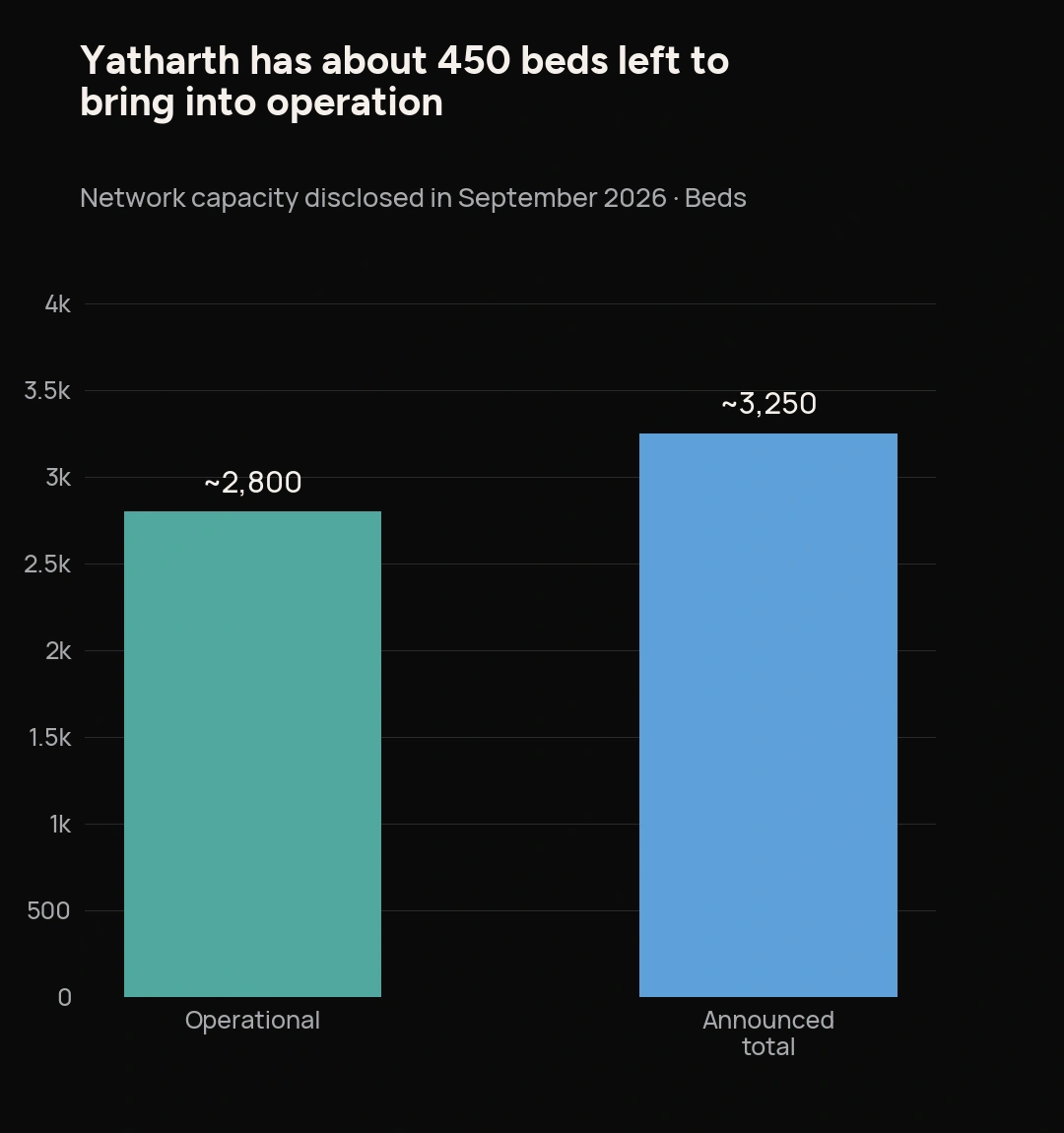
Chart: Technology Index · Data: Advent International
The difference between the two rounded figures is about 450 beds. “Announced capacity” may include beds at different stages of readiness. A site-by-site opening schedule would show how quickly that capacity could become productive.
Hospital expansion has several bottlenecks that money cannot remove instantly. Clinical hiring, licences, equipment, referral networks and payer relationships need to develop together. A bed can be physically available before it contributes meaningfully to revenue. Conversely, an acquisition can add capacity quickly but introduce integration and pricing risk.
Yatharth has said Advent will bring healthcare expertise and global insight alongside capital. The measurable proof will be disclosure of commissioning dates, occupancy, average revenue per occupied bed, margins at new units and the share of growth coming from acquisitions.
The market reaction is not the investment case
Reuters reported that Yatharth shares rose as much as 8.6% to a record ₹1,067 after the announcement. That move shows investors welcomed the capital and sponsor. It does not establish the valuation Advent will ultimately earn on converted warrants or the returns Yatharth will generate from deploying the proceeds.
The transaction also fits a broader pattern of private equity moving into Indian healthcare. Reuters cited KKR’s $1.4 billion agreement for Medicover’s India business and earlier investments by Blackstone and BPEA EQT. That backdrop supports the sector’s strategic appeal, while raising the bar for assets, clinicians and acquisition prices.
For Yatharth, the cleanest near-term scorecard has four lines: shareholder approval, transaction completion, a disclosed use-of-proceeds plan and the conversion of announced capacity into operating beds. After that, occupancy and unit economics matter more than the bed count itself.
Primary capital creates choices as well as capacity
Because the investment is described as primary capital, the proceeds are intended for the company rather than a simple cash exit by existing holders. That gives Yatharth room to build, acquire or strengthen the balance sheet. Advent’s announcement does not allocate the ₹3,150 crore among those uses.
The allocation will affect the risk profile. New hospitals require a slower operating ramp but can be designed around the company’s systems. Acquisitions can add revenue faster while introducing integration, purchase-price and clinical-governance risk. Debt repayment may improve resilience without directly adding beds. A credible use-of-proceeds schedule should distinguish those paths.
The warrant structure adds timing to the capital story. Cash and ownership may arrive in stages as warrants are exercised, subject to the transaction terms. The company’s expansion plan should therefore be tested against capital actually received, not only the maximum announced amount.
For patients and clinicians, the relevant output is not financial capacity alone. Yatharth will need to show that growth preserves staffing ratios, specialist coverage, infection control and clinical outcomes. Those measures do not appear in the launch-day deal reports, but they belong beside occupancy and revenue in any assessment of a hospital expansion.
Advent is buying a substantial minority and funding growth. The next evidence investors need is an opening schedule, followed by occupancy and earnings from the new hospitals.
One email. Saturday morning.
The week that mattered.
The five stories you needed to read, the data point of the week, and what to watch. From Technology Index editors. No ads, no fluff.