


Anthropic’s $2 billion safety plan puts AI’s watchdog inside the lab
Anthropic and Accenture want evaluators working alongside model developers. Their power to publish uncomfortable findings will determine whether the oversight is independent.
Anthropic and Accenture each expect to invest at least $1 billion over five years to build capacity for evaluating advanced AI models. Accenture’s specialist AI business, Faculty, will lead red-teaming, alignment assessments and safeguard testing. The September 18 announcement sets out the spending ambition but leaves the evaluator’s independence and public reporting rules unresolved.
Anthropic calls the approach “embedded evaluation”. Evaluators would work inside AI companies with access comparable to an employee, allowing them to observe training, deployment decisions and internal processes. That could solve a real weakness in conventional external audits, which often see a model only after major design choices have been made.
But access and independence are not synonyms. If the developer helps fund the evaluator, controls access and can influence what becomes public, an embedded team may know more without being able to say more. The commercial importance of the partnership therefore lies less in the $2 billion headline than in the publication, escalation and conflict rules left unresolved in the announcement.
Embedded access addresses the information gap
In its announcement, Anthropic said embedded evaluators could watch models take shape, follow the decisions that govern how systems are built and deployed, and speak directly with employees. The company also acknowledged that many operating details are still being worked out.
That candour matters. Frontier-model evaluation is difficult because behaviour can change with tools, system instructions and access to external services. A short pre-release test may not reproduce the conditions under which an agent is used in a company. An evaluator placed earlier in the development cycle can test assumptions before they harden into product decisions.
Reuters reported that Faculty will test safeguards and conduct alignment work. Accenture also brings knowledge of how enterprises deploy AI, which can help evaluations move beyond laboratory prompts into workflows involving data, permissions and business processes.
The evaluator is inside a commercial relationship
The same structure creates a potential conflict that technical expertise alone cannot resolve. Accenture is funding the programme, leads the evaluating unit and is also a major seller of AI transformation services. Anthropic supplies models to enterprise customers. Both benefit if embedded evaluation increases confidence in deployment.
Accenture’s existing AI business shows the commercial context. It reported $5.9 billion in generative AI bookings in FY2025, up from $3 billion in FY2024. Revenue rose from nearly $900 million to $2.7 billion. The FY2025 disclosure includes increasing agentic AI activity. Bookings measure contract commitments and are separate from recognised revenue.
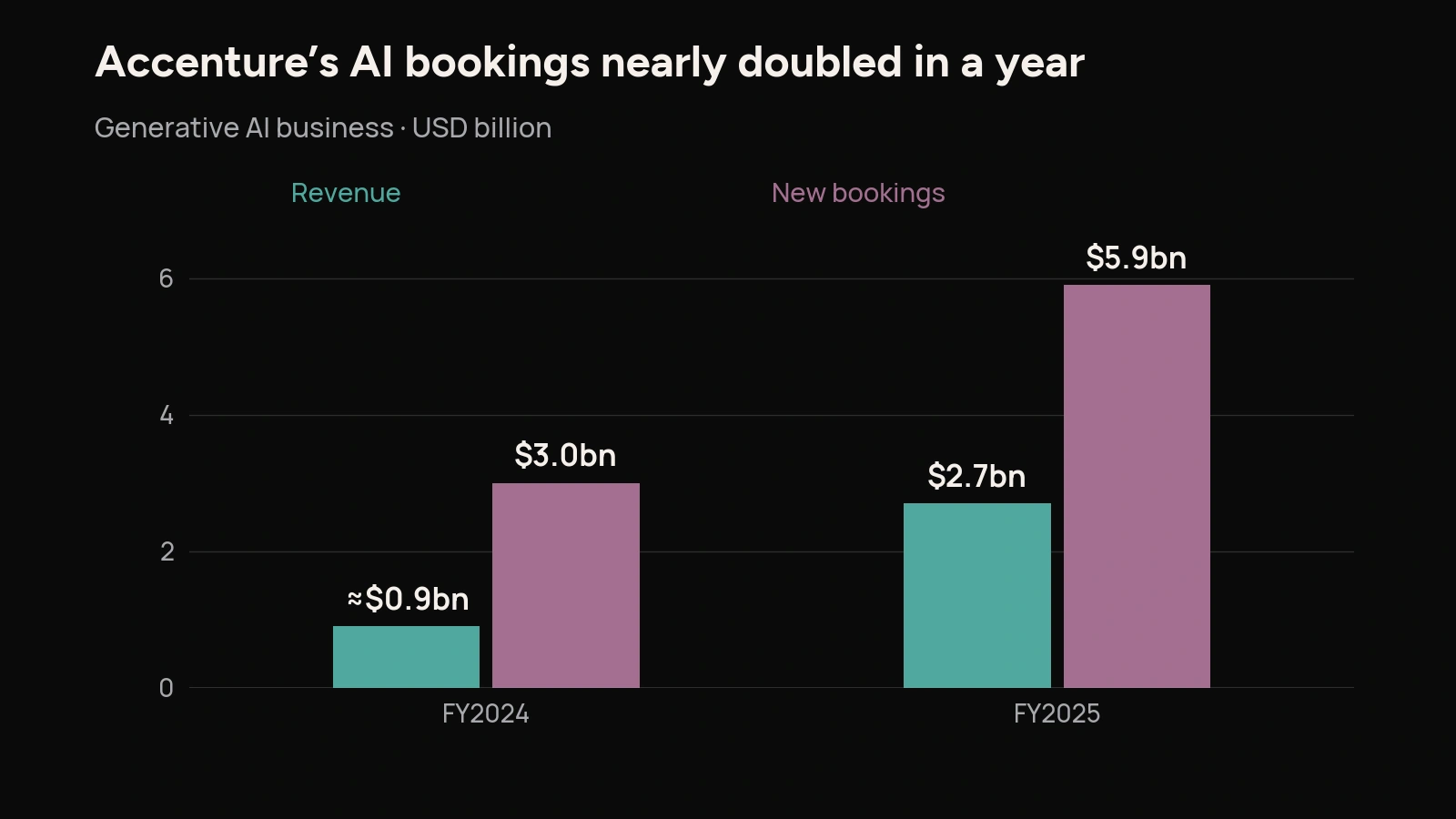
Chart: Technology Index · Data: Accenture FY2024 · Accenture FY2025
That does not make the work invalid. It means the word independent needs a testable definition. A strong arrangement would protect an evaluator’s right to choose tests, preserve access when findings are uncomfortable, document disagreements and publish material risks on a defined timetable.
The announcement says the partnership is non-exclusive and that the companies intend to work with other evaluators and AI developers. Diversity can reduce dependence on one relationship. It does not answer whether two evaluators will see the same evidence or whether a developer can shop for the most favourable conclusion.
Enterprises need findings they can use
For chief information security officers and risk committees, a general statement that a model was red-teamed is not enough. They need to know the model version, tool permissions, test environment, failure definitions and residual risk. Results also need to be connected to controls that a customer can implement.
Embedded evaluators could provide better evidence because they can see internal mitigations and emerging capabilities. Yet customers may be unable to rely on that evidence if reports are selective or too abstract to compare. A common disclosure format would make the programme more valuable than a collection of bespoke assurances.
The spending commitment also raises a capacity question. Evaluation requires scarce technical staff, secure infrastructure and repeated testing as models change. Money can build that capability. It can also create an evaluation industry economically dependent on the companies it assesses.
There is a second customer-side risk. An enterprise may treat the existence of an embedded evaluation programme as a substitute for its own controls. Model-level testing cannot know every customer’s data permissions, tool connections, escalation paths or tolerance for failure. Buyers will still need deployment-specific assurance and monitoring, even if the underlying model has been examined more deeply.
Four governance rules would make the approach credible
First, the evaluator should have protected authority to publish material findings, with only narrow delays for remediation or security. Second, funding should not depend on a favourable result. Third, the programme should disclose which model versions and deployment conditions were tested. Fourth, an external body should receive unresolved disagreements and serious incidents.
None of those rules needs the evaluator to be distant from the lab. The value of embedded evaluation comes from proximity. The credibility of evaluation comes from what the evaluator can do when proximity reveals a problem.
The proposed spending could make model evaluation a durable function. The partnership will deserve the label independent only when its governance gives evaluators rights that survive commercial pressure.
A published charter should now set out access, publication rights, escalation and the treatment of conflicts. It would let customers and regulators judge how the programme handles findings that either company would rather keep private.
One email. Saturday morning.
The week that mattered.
The five stories you needed to read, the data point of the week, and what to watch. From Technology Index editors. No ads, no fluff.