


Apple Pay launches in India with one bank
Apple’s September 30 launch starts with eligible Axis credit cards. Repeat use, more issuers and merchant acceptance will decide how far it goes.
Apple Pay launched in India on September 30, initially supporting eligible Axis Bank Visa and Mastercard credit cards. The service is available on iPhone, Apple Watch and iPad. The launch gives Apple a foothold in a large payments market through a single bank’s cardholders.
UPI accounts for 84% of India’s digital transaction volume, Reuters reported at the launch. Apple Pay starts as a card wallet, offering contactless payments in stores and checkout in apps and on the web. Its early competitors include physical cards, bank apps and other ways of using card credentials.
The business case rests on a narrow but valuable wedge: make high-spending card customers use their cards more often, give Axis a differentiated experience and then add more issuers. The larger story will be whether Apple can turn that wedge into a broadly accepted wallet without weakening the simple user experience that makes the product useful.
Axis gives Apple a controlled starting point
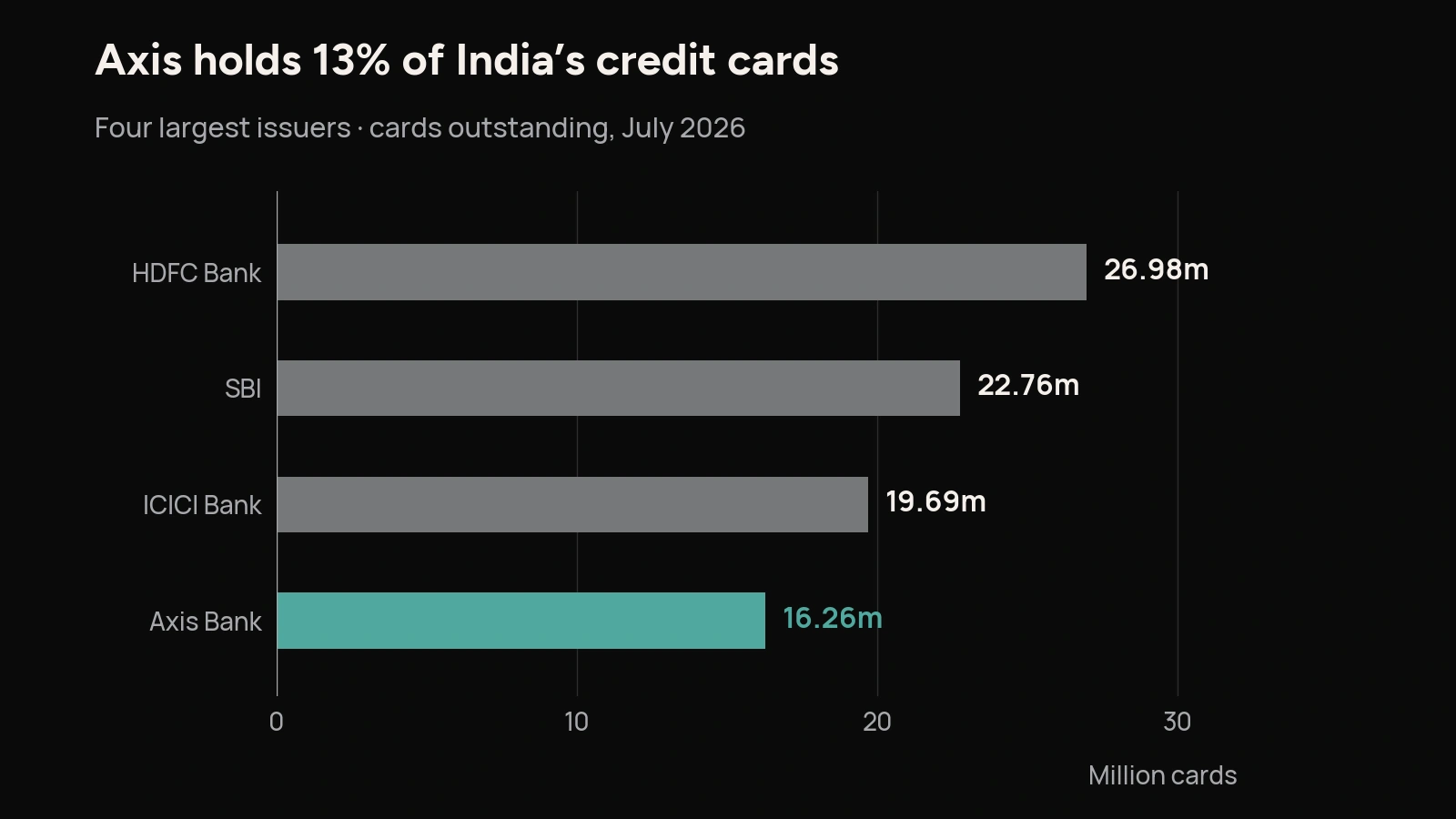
Axis had about 16.26 million credit cards outstanding in July 2026, according to Reserve Bank of India statistics. That July 2026 count gives a sense of the bank’s scale; only a subset of those cards and their holders will qualify for, and choose to use, Apple Pay.
Axis accounted for 13.2% of India’s credit cards outstanding at the end of July, according to RBI’s provisional statistics. HDFC Bank, SBI and ICICI Bank each had a larger base. These are card counts, rather than unique customers or prospective Apple Pay users.
A single-bank start limits reach, but it also reduces the number of systems and customer-support paths that must work on day one. Token provisioning, authentication, lost-device controls, refunds and merchant acceptance all need to operate reliably. A phased launch lets Apple and Axis find failures before more issuers multiply them.
Axis gets a potential acquisition and engagement tool for premium cardholders. Apple gets a bank willing to complete the integration and carry the first wave of customer questions. Neither party has disclosed pricing, incentives or exclusivity, so the commercial balance cannot yet be judged.
UPI changes the comparison
In markets where contactless cards are already the default retail payment, Apple Pay often replaces the act of presenting plastic. India’s payment behaviour is different. UPI lets a customer pay from a bank account using a QR code and a familiar app, often without a card in the transaction.
That means Apple Pay does not win merely by being faster than inserting a card. It must be useful at merchants where card acceptance is present, for in-app and online checkout, and for customers who value rewards or credit. The service can grow even if UPI keeps dominating transaction count, because card payments may carry different ticket sizes and economics.
The launch also follows regulatory changes that allow biometric authentication for card payments, Reuters said. That supports Apple’s device-based model, but regulatory permission is only one layer. Banks still need risk rules, customer consent and dispute handling that match Indian requirements.
The iPhone base is valuable but bounded
Reuters, citing Counterpoint Research, reported that Apple’s share of India’s smartphone market had doubled to 8% since 2022. That market-share figure does not identify the installed base of compatible devices or how many owners hold an eligible card.
Still, iPhone users are likely to be disproportionately attractive to card issuers and premium merchants. That can make a limited audience commercially meaningful. Apple Pay can also strengthen the wider Apple ecosystem by making the iPhone and Apple Watch more useful in everyday transactions.
The constraint is network breadth. Customers will notice missing banks and cards immediately. Merchants need compatible contactless terminals, and checkout staff need to recognise the payment flow. A polished wallet with patchy issuer support can feel less convenient than the existing QR habit.
Three milestones will show whether the launch travels
The first milestone is issuer expansion. HDFC Bank and ICICI Bank would materially broaden the card base if agreements are completed. Reuters reported on September 30 that discussions with the banks had not produced final agreements.
The second is active use, not enrolment. Apple and Axis will need to show that customers keep paying after adding a card, particularly outside travel and premium retail. The third is merchant and product breadth: contactless acceptance, in-app checkout, web payments and support across card networks.
Apple Pay’s India arrival is strategically important because a major global wallet is finally adapting to local authentication and banking conditions. It is not evidence that India’s payment hierarchy has changed. The first version is a card convenience product inside an iPhone ecosystem, entering a market where UPI already owns the mass habit.
Repeat payments by Axis cardholders will matter more than launch-day enrolments. Adding banks smoothly and giving merchants incremental spending would provide a commercial reason to expand the service.
One email. Saturday morning.
The week that mattered.
The five stories you needed to read, the data point of the week, and what to watch. From Technology Index editors. No ads, no fluff.