


Brookfield’s $600 million ACME bet enters a shrinking hydrogen pipeline
The deal gives ACME a major sponsor as the global hydrogen project pipeline contracts. Offtake, power costs and financial close will decide which plants get built.
Brookfield announced on September 17 that it had agreed to invest up to $600 million in ACME Cleantech Ventures, giving the Indian group’s green-ammonia and green-methanol pipeline an institutional sponsor. The announced ceiling says little about when capital will be drawn or which projects will reach financial close.
The companies have described a capital ceiling for a portfolio in India and Oman, not money already deployed into commissioned plants. Financial Express reported that the transaction is structured as equity, while the valuation and stake were expected to be finalised by the end of 2026. The announcements did not disclose a drawdown schedule, project-level allocation or construction budget.
That makes the announcement a useful test of how energy-transition capital moves from a platform commitment to operating assets. Four disclosed projects have to secure land, renewable power, electrolysers, logistics, financing and customers on terms that work together. Customer agreements help, but their terms must support the cost of construction and production.
The capital attaches to a pipeline, not one plant
The wider industry has struggled to turn announcements into plants. The IEA’s 2026 review puts potential 2030 production from announced low-emissions hydrogen projects at 27 million tonnes a year. That compares with 37 million in its 2025 review and 49 million in 2024. These are successive assessments of future capacity, not a decline in actual output.
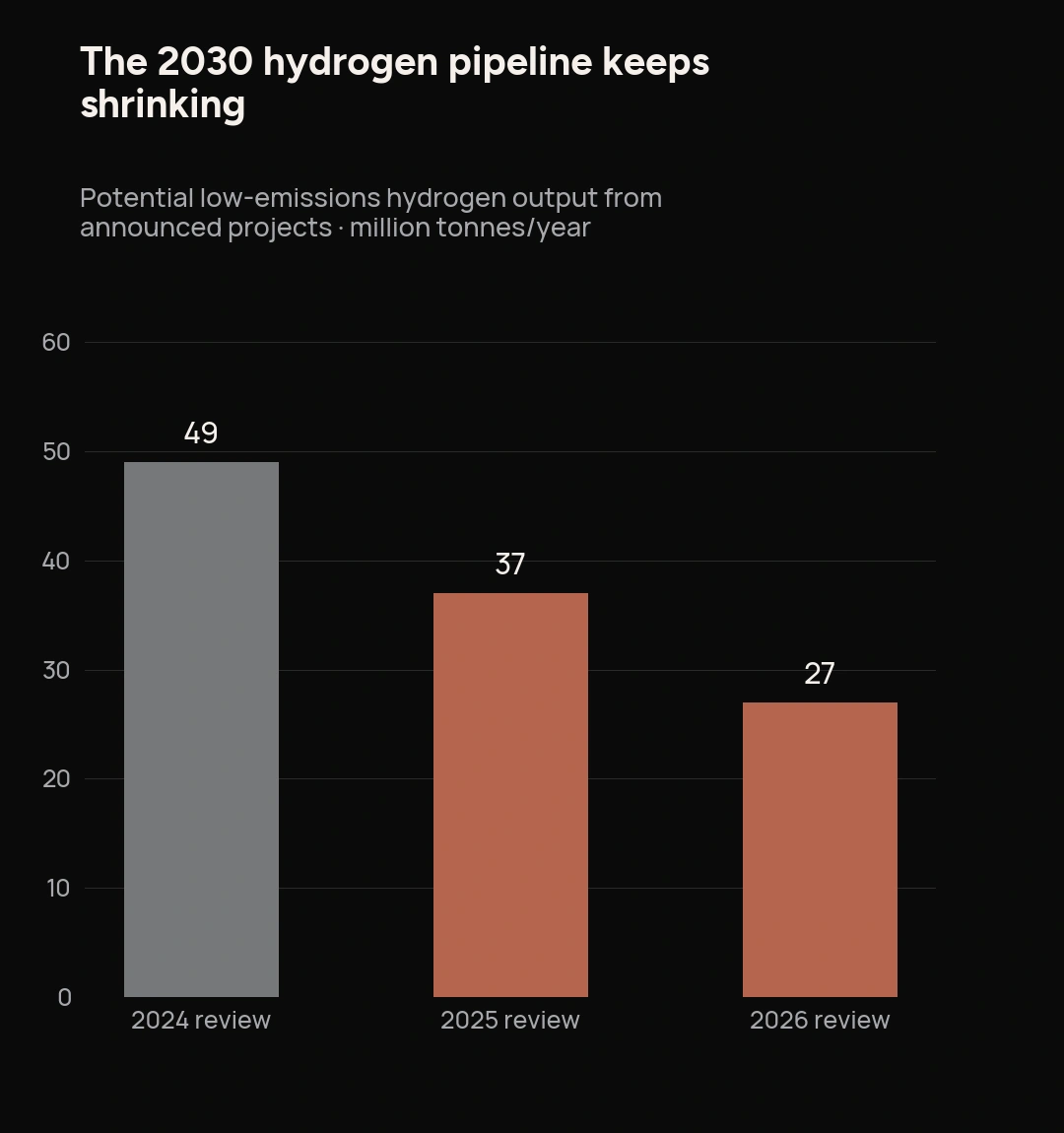
Chart: Technology Index · Data: IEA 2026 · IEA 2025
Reuters reported that Brookfield will invest through its Global Transition Fund strategy to help ACME develop and build green-ammonia and green-methanol projects. ACME said the pipeline covers India and Oman and is intended to serve domestic and export markets.
Financial Express provided the more specific capital map: Phase 2 of ACME’s Oman project, two green-ammonia projects in Odisha and a green-methanol project in Odisha. Phase 1 in Oman was described as fully funded. On that disclosure, three of the four named destinations are in Odisha.
Comparable output, capital cost and completion dates have not been disclosed for all four projects. Odisha is the centre of the disclosed Indian build-out, while the Oman phase extends ACME’s export platform.
Brookfield brings experience across power and infrastructure. Reuters said it has about 50 gigawatts of operating and pipeline wind and solar assets in India. That figure should not be read as 50 GW already running: it combines operating projects with development-stage assets. The relevant advantage is the ability to connect renewable generation, long-duration capital and complex project development.
Customer contracts still need financing
ACME has named Yara International, IHI Corporation and Mitsubishi Gas Chemical among customers with supply agreements, along with Indian buyers. Those names reduce one obvious uncertainty: whether credible industrial counterparties are interested in low-carbon molecules.
Some earlier contract details are public. Yara announced a binding agreement in March 2024 for 100,000 tonnes a year of renewable ammonia from ACME’s Oman Phase 1, with a then-expected start in 2027. The full portfolio’s pricing formulas, credit support and output coverage remain undisclosed, limiting an outside assessment of project borrowing.
This is where green-fuels projects differ from a simple renewable-power asset. Electricity must be converted into hydrogen and then into ammonia or methanol, often for export. Every conversion adds equipment, energy loss, logistics and certification requirements. The customer may be buying a molecule partly for its emissions attributes, which makes definitions and verification commercially important.
ACME’s chairman described the offtake contracts as long-term and bankable in Financial Express. That is a company claim. The financing evidence will arrive when lenders commit, project documents disclose debt and equity, and construction proceeds against contracted milestones.
The equity terms still matter
Financial Express reported that valuation and the stake to be sold were expected to be finalised by year-end. Until then, $600 million cannot be translated into an ownership percentage or an implied platform valuation. It is also unclear whether the full amount enters the company at closing, is released against milestones or includes future options.
Those mechanics affect both parties. ACME needs enough committed equity to order equipment and support project borrowing. Brookfield needs controls that protect capital through development delays and cost changes. Governance rights, reserved matters, dilution protections and project-level ownership can be as consequential as the headline cheque.
The phrase “up to” also preserves flexibility. It can allow capital to follow projects that clear their permits and contracts first. It can equally mean that the maximum is never reached. The announced ceiling should therefore be tracked as a commitment, not booked as completed investment.
Financing and construction come next
The first gate is transaction closure: valuation, stake, governance and the funding schedule. The second is contracted economics: volumes, tenure and price formulas that cover power, conversion and logistics. The third is construction: equipment orders, financing, permits and a credible commissioning plan. The fourth is operation: delivered output that meets the buyer’s specification and carbon-accounting rules.
Each gate can fail independently. Cheap renewable power does not compensate for an unreliable electrolyser. A completed plant does not create cash flow if the customer can defer deliveries. A supply agreement does not solve port or storage constraints. A global customer does not guarantee a price that earns the sponsor’s return.
For Indian industrial policy, the Odisha concentration creates an additional question: how much of the equipment, engineering and operating capability will be built locally. The announcement supports projects in India, but it does not quantify domestic procurement or manufacturing. Those numbers will determine whether the investment creates only molecule output or also a supplier base.
Power is the hidden operating input
Green ammonia and green methanol are often discussed as fuel products, but their economics begin with electricity. Electrolysers require a large and dependable supply of renewable power. A project with an attractive equipment cost can still miss its target if power is expensive, intermittent or delivered later than the conversion plant.
That makes the relationship between ACME’s molecules platform and renewable generation commercially important. The announcement does not disclose the power price, the generation assets tied to each project, storage assumptions or the share of electricity covered by long-term arrangements. Those inputs will determine utilisation and delivered cost.
The location choice also creates different operating chains. Odisha projects need domestic grid, land, water, industrial and port coordination. Oman’s export proposition depends on its own power and logistics system. Treating all four as one portfolio can diversify geography, but it does not make the projects interchangeable.
For Brookfield, staged capital can be a way to manage that variation. Projects that clear power and customer conditions first can move ahead first. For ACME, however, a flexible sponsor commitment must still translate into firm capital when equipment orders and construction payments fall due. The final agreements should show how that timing risk is divided.
Customer contracts must survive the certification test
Yara’s March 2024 announcement described an Oman development planned to reach 900,000 tonnes a year in phases. Its own 100,000-tonne agreement covered supply from Phase 1. The figures show the scale difference between the overall plan and that disclosed contract; they do not establish the proportion uncontracted today.
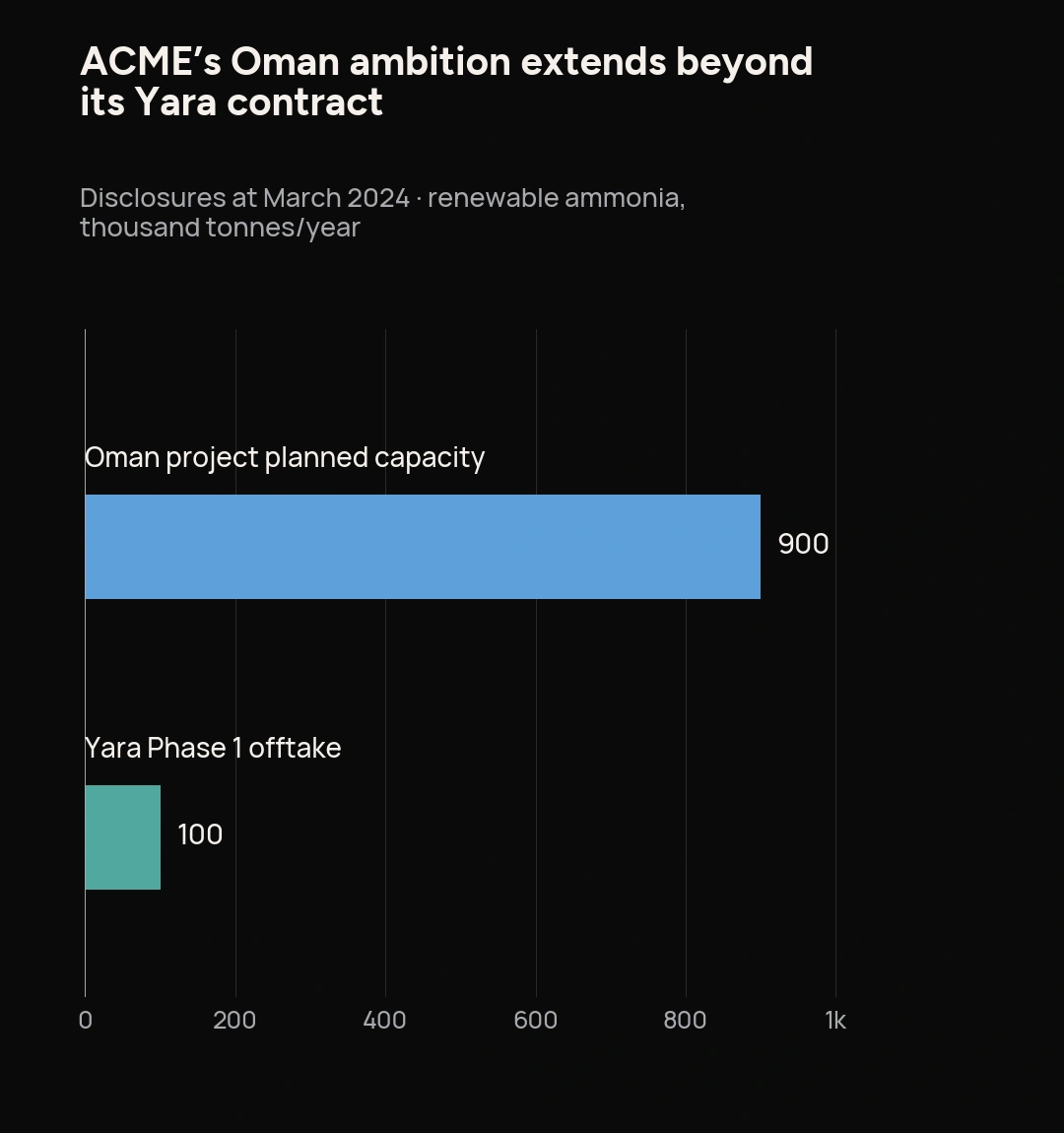
Chart: Technology Index · Data: Yara International
Low-carbon molecules carry two products at once: the physical fuel and the emissions claim attached to it. Buyers need confidence that the electricity source, production process and lifecycle accounting satisfy the rules of their target market. A molecule can meet a chemical specification and still fail to receive the expected regulatory treatment.
The named counterparties show that ACME has reached serious industrial customers. The next level of evidence is whether contracts specify certification, delivery points, penalties and treatment of regulatory change. Those terms influence both revenue and financing because lenders need to know what happens if a standard changes before the plant is commissioned.
India’s domestic market adds another route. If Indian buyers take part of the output, projects may be less dependent on export infrastructure and overseas regulation. The companies have not disclosed the domestic-export split. That is therefore a strategic option, not a measurable hedge in the current evidence.
Portfolio capital should not obscure project accountability
A platform investment can pool engineering and purchasing, reducing duplication across projects. It can also make outside assessment harder when performance is reported only at the portfolio level. Project-level capacity, cost, financing and schedules are the minimum information needed to distinguish progress at one asset from delay at another.
The four-project list provides a starting inventory. A useful future update would keep that inventory stable and report which projects have reached financial close, notice to proceed, mechanical completion and commercial operation. Adding new pipeline names without closing old milestones would increase announced scale without increasing delivered capacity.
That reporting discipline also protects the headline commitment from being double counted across years. Capital announced, capital legally committed, capital drawn and capital spent are different measures. ACME and Brookfield can make the partnership easier to assess by publishing each one separately.
Brookfield’s involvement can help ACME secure finance and coordinate development. Signed project loans, construction progress and deliveries will show how much of the announced commitment becomes operating capacity.
The documents investors need next
The most useful next disclosures are the final ownership structure, capital committed at closing, project-level capacity and cost, and the proportion of planned output under contract. Financial close and equipment orders would then show which projects are moving beyond the announced pipeline.
One email. Saturday morning.
The week that mattered.
The five stories you needed to read, the data point of the week, and what to watch. From Technology Index editors. No ads, no fluff.