


Karnataka’s 1 GW data‑centre plan hinges on efficiency rules
The state’s new policy puts efficiency at the centre of its data-centre push. Developers still need the rules for qualifying, measuring performance and keeping incentives.
In September 2026, Karnataka approved a five-year sustainable data-centre policy with a headline target of 1 GW of cumulative IT load by 2031. The state has attached a ₹1,300.45 crore implementation framework to the plan and says incentives will be linked to power and water efficiency. The next policy documents must show how those efficiency conditions will be measured and enforced.
The commercial value of the policy will turn on its efficiency thresholds, measurement periods, verification rules and consequences for missing them. The September announcement did not set out those mechanics. Developers need them to calculate whether a project qualifies and how much support it can retain once it is operating.
That distinction matters because the new framework appears to change what the state is trying to reward. Karnataka’s 2022 policy used relatively clear input and location tests, including renewable-energy shares and incentives for projects outside Bengaluru. The 2026 announcement puts greater weight on measured outcomes, including Power Usage Effectiveness and Water Usage Effectiveness. If that shift survives the detailed rules, it could make resource performance part of project economics rather than an optional sustainability claim.
“Our objective is not simply to add more capacity, but to build the right capacity, in the right locations and with the right infrastructure.”
Karnataka IT Minister Priyank Kharge set out that aim when announcing the policy, according to The Indian Express.
The policy changes the incentive test
The official 2022 policy page offered a 100% electricity-duty exemption for five years from commercial operation. Data centres sourcing more than 50% renewable energy could receive a green-tariff reimbursement of ₹0.50 per unit for five years, subject to capacity and rupee caps. Industrial power tariff eligibility required at least a 30% green-energy component in total consumption.
Those rules rewarded a project for how it sourced electricity and where it located. Land-conversion, stamp-duty, land and capital support were directed towards projects outside Bengaluru Urban district. The policy already mentioned energy-efficient design, but its most visible published conditions were input shares, tariff treatment and location incentives.
The new framework shifts the operating burden
The 2026 announcement says incentives will be linked to power and water efficiency. Reporting by the Indian Express and Moneycontrol says the framework provides for monitoring PUE and WUE, alongside renewable energy, advanced cooling and water management.
That is a potentially important move from qualifying inputs to operating results. It is not yet possible to judge its force. The September announcement did not state whether eligibility will depend on design estimates or measured performance, whether operators will report annually or continuously, or whether weaker performance reduces a subsidy already awarded.
For developers, the difference is financial. A renewable-energy procurement threshold can be modelled before construction. A performance-linked incentive depends on cooling design, server utilisation, weather, water source, commissioning and measurement boundaries. That transfers part of the policy risk from the application desk to the operating floor.
Bengaluru starts behind the leading hubs
Karnataka’s ambition is large relative to Bengaluru’s March 2026 reported footprint, although the two figures are not directly comparable. The state target covers cumulative capacity across Karnataka by 2031. The city figure is an operational estimate published in March 2026.
A March 18 release from the Ministry of Electronics and Information Technology, citing industry figures, put Mumbai and Navi Mumbai at 790 MW of operational capacity, Chennai at 305 MW, Bengaluru at 182 MW, Hyderabad at 152 MW and Delhi-NCR/Noida at 76 MW. On those figures, Mumbai’s footprint was more than four times Bengaluru’s.
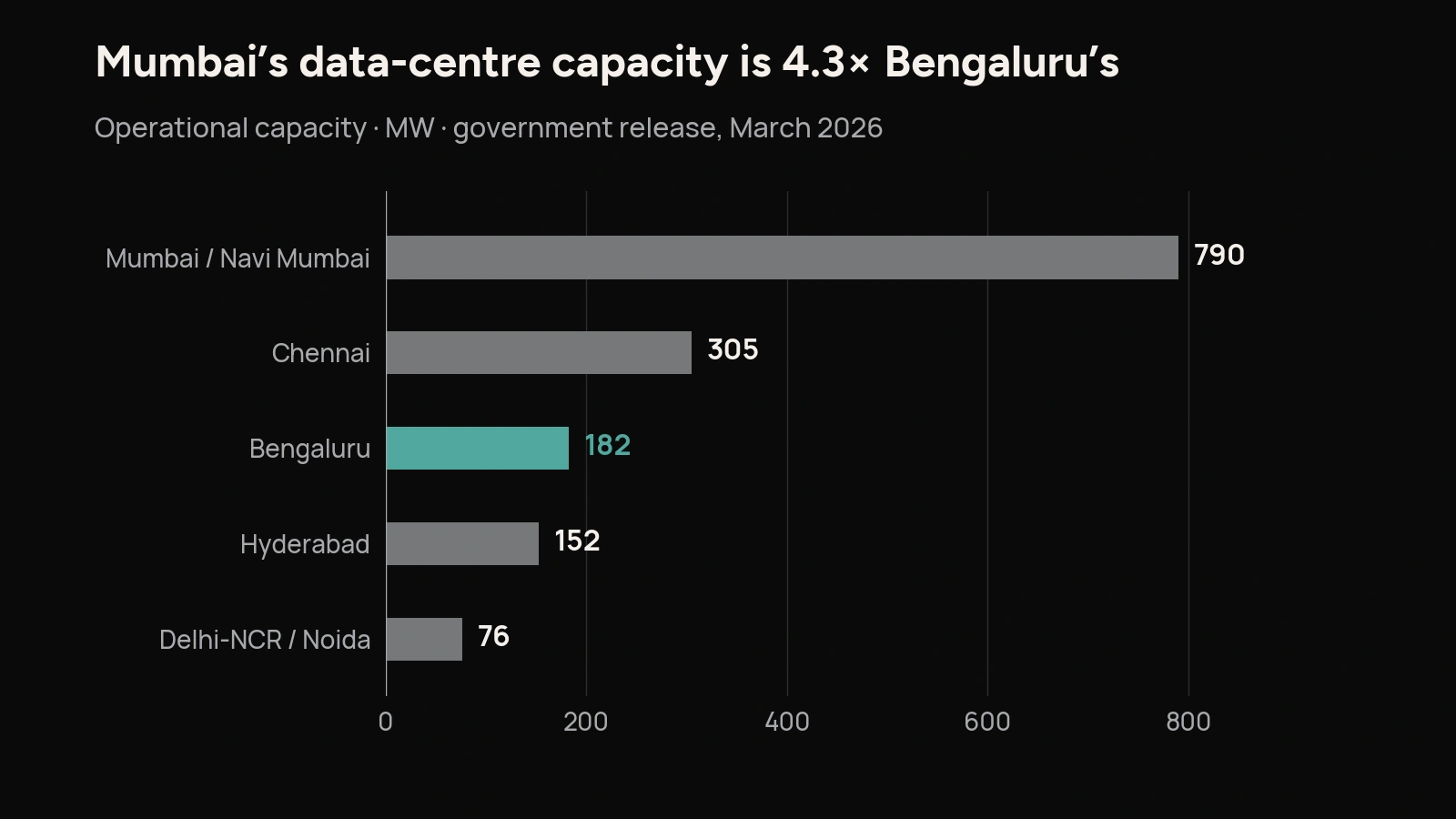
Chart: Technology Index · Data: MeitY / PIB
Why the technology cluster is not enough
The comparison does not mean Karnataka must reproduce Mumbai’s model. Mumbai’s lead is tied partly to enterprise demand and submarine-cable connectivity. Chennai also benefits from cable landings. Bengaluru has the cloud customers, engineering talent and enterprise technology base, but those advantages do not generate transmission capacity, water availability or international cable routes by themselves.
That is why the policy’s support for cable landing stations, edge facilities and new corridors beyond Bengaluru is an infrastructure decision, not merely regional-development language. It is an attempt to assemble physical infrastructure around the state’s existing demand and talent base. The ₹1,300.45 crore framework must reduce coordination risk across utilities, land, networks and approvals, rather than only subsidising buildings.
The national market is moving quickly. An August government release put India’s installed data-centre capacity at about 1,575 MW, up from 375 MW in 2020. A September PIB backgrounder projected nearly 8 GW by 2030. The projection is separate from capacity already operating. States are competing during a rapid build-out, and delayed rules can shift projects elsewhere.
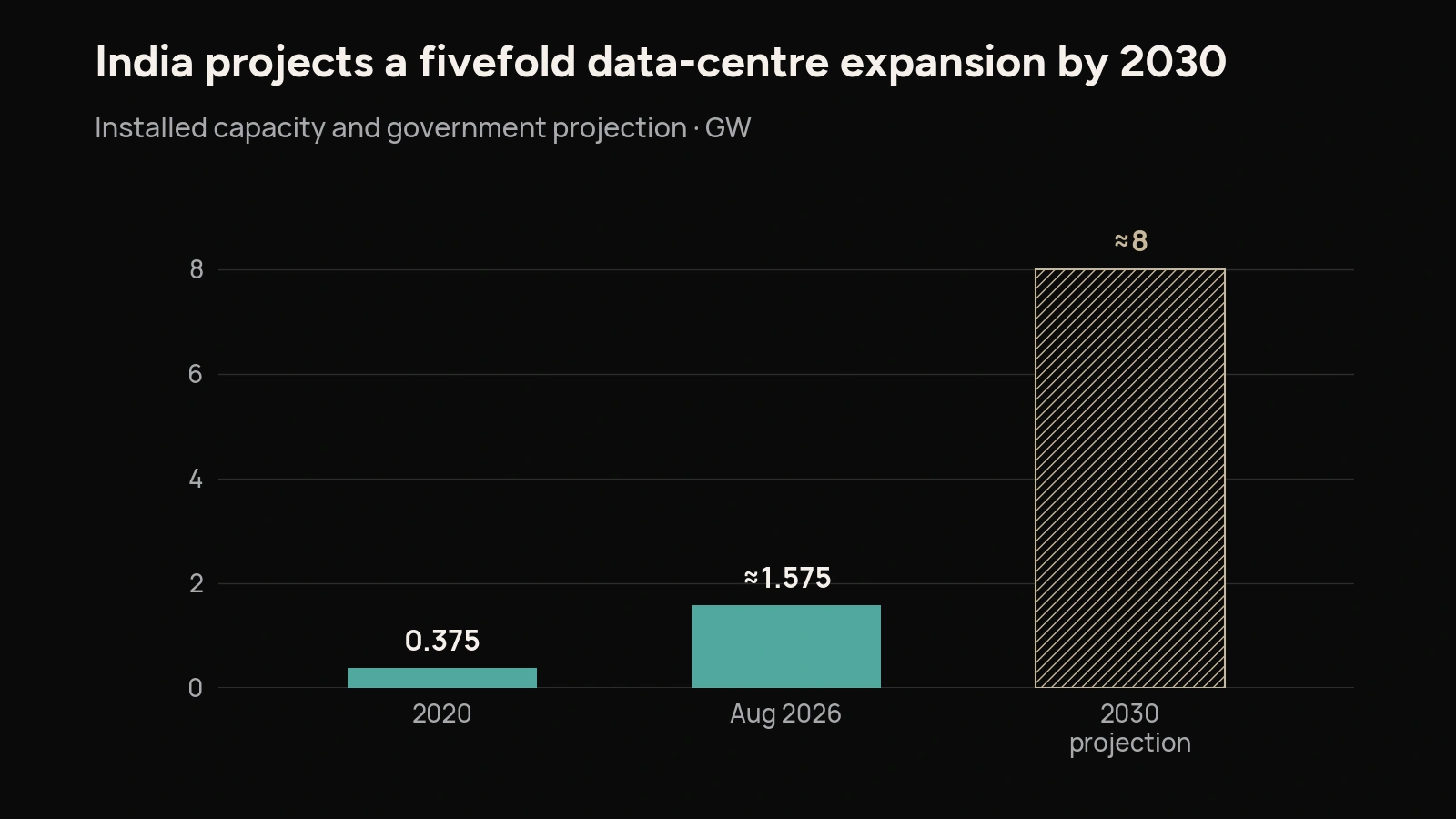
Chart: Technology Index · Data: PIB, August 2026 · PIB, September 2026
The baseline must separate live and planned capacity
The gap also cautions against treating 1 GW as a simple addition to Bengaluru’s reported 182 MW. The target is state-wide and cumulative, while the comparison is a city snapshot cited by the government in March. A useful implementation baseline would separate operating capacity, committed projects and unallocated ambition across Bengaluru, Mysuru, Mangaluru and any new corridor. Without that baseline, progress towards 1 GW will be difficult to audit.
That baseline should use one definition of IT load and distinguish live, contracted and planned capacity. It should also carry verification dates and project milestones. Grid and water requirements attach to energised capacity, not memoranda of understanding, while performance-linked incentives cannot be evaluated until a facility operates. A published baseline would show whether the state’s outlay is enabling constrained new capacity or supporting projects that were already likely to proceed.
Efficiency needs a common measure
PUE compares the energy used by an entire facility with the energy delivered to its IT equipment. WUE tracks water used in operations against IT equipment energy. The Green Grid’s definition expresses WUE in litres per kilowatt-hour and also warns that reducing water use on site can sometimes increase energy use. That trade-off is precisely why the two measures should be read together.
A target without a boundary can still mislead. Karnataka will have to specify whether PUE is measured at peak conditions or across a year, whether renewable generation outside the facility affects the calculation, which water sources count, and how recycled water is treated. New facilities may also perform differently during commissioning from mature operations.
Verification determines who keeps the incentive
The verification model matters as much as the threshold. Self-reported annual averages, utility-meter data and independently assured disclosures provide different levels of confidence. Public reporting may also be necessary if the state wants citizens and customers to see whether incentives are buying better resource performance.
None of this argues for one universal number. Climate, workload, cooling architecture and facility age all affect performance. It argues for a published method that prevents operators from choosing the most flattering boundary. The policy becomes credible when two competing projects can calculate eligibility the same way and when the state can withdraw or reduce support if the promised efficiency does not materialise.
Beyond Bengaluru is an infrastructure decision
The government says it will use resource heat mapping to assess power and water availability and guide site selection. It also proposes sustainable data-centre zones or parks and a Centre of Excellence. These are sensible planning devices, but only if the map changes decisions.
A heat map that sits beside an incentives portal is informational. A heat map that determines where a project can receive a fast grid connection, land support or performance-linked subsidy becomes policy. Karnataka will also need to show how it handles cumulative effects when several large facilities seek capacity in the same power or water basin.
Implementation depends on decision rights
Implementation responsibility is spread across several bodies. According to the Indian Express report, the Department of Electronics, IT, Biotechnology and Science & Technology will roll out the policy, Karnataka Innovation and Technology Society will serve as the registration and implementation interface, and Karnataka Udyoga Mitra will act as the single-window clearance agency.
That structure can work if the single window owns decisions rather than merely routing files. In May, before the new policy was approved, Moneycontrol reported that KITS planned to hire a consultant to operationalise incentives under the earlier policy and digitise applications. The history makes service levels, decision rights and published processing times material parts of the 2026 framework.
The next policy release has four operating tests
Four disclosures will show whether the policy has moved from intent to an investable rulebook:
- Metric thresholds and boundaries. Operators need the PUE and WUE levels, the measurement period and the treatment of recycled water, renewable power and commissioning.
- Incentive consequences. The rules should say whether weaker performance reduces, delays or claws back support, and how long projects have to cure a miss.
- Zone and connection criteria. Resource heat maps should connect directly to land availability, grid capacity, water conditions, fibre routes and clearance timelines.
- Public accountability. A standard reporting format for capacity, power, water and incentive disbursement would allow the state to demonstrate that growth is meeting its own conditions.
The government’s phased roadmap, as reported by Moneycontrol, begins with operationalisation, investor facilitation and identification of zones and parks before moving into ecosystem expansion, research, skilling and sustainability-linked incentives. That sequence makes the next release more important than another investment announcement.
Karnataka needs a repeatable system for choosing sites, allocating scarce infrastructure and paying for resource performance that can be verified. If the state publishes hard rules and enforces them, it can offer developers something more valuable than a subsidy: predictable permission to grow. Until then, the 1 GW figure remains a target whose operating conditions are still being written.
One email. Saturday morning.
The week that mattered.
The five stories you needed to read, the data point of the week, and what to watch. From Technology Index editors. No ads, no fluff.