


Pocket FM wants AI to triple its margin while it takes on new markets
Its co-founder is targeting a 15%–20% EBITDA margin, up from roughly 5%. Cheaper production must cover the cost of expansion, new formats and finding listeners.
Pocket FM says artificial intelligence can help lift its EBITDA margin from roughly 5% to 15%–20% while it expands into more countries and content formats. The target has no announced deadline, and new markets will add costs before they contribute at scale.
Co-founder Prateek Dixit told Inc42 that AI powers about 90% of production, all post-production and 80%–90% of creative processes. In September, Pocket FM said it planned to enter Japan and South Korea within six to eight months.
Moving from 5% to 15%–20% means adding 10–15 percentage points to the margin rate, or reaching three to four times the current percentage. That is not a routine efficiency gain. It requires production savings to exceed the costs of more content, new markets and product experiments.
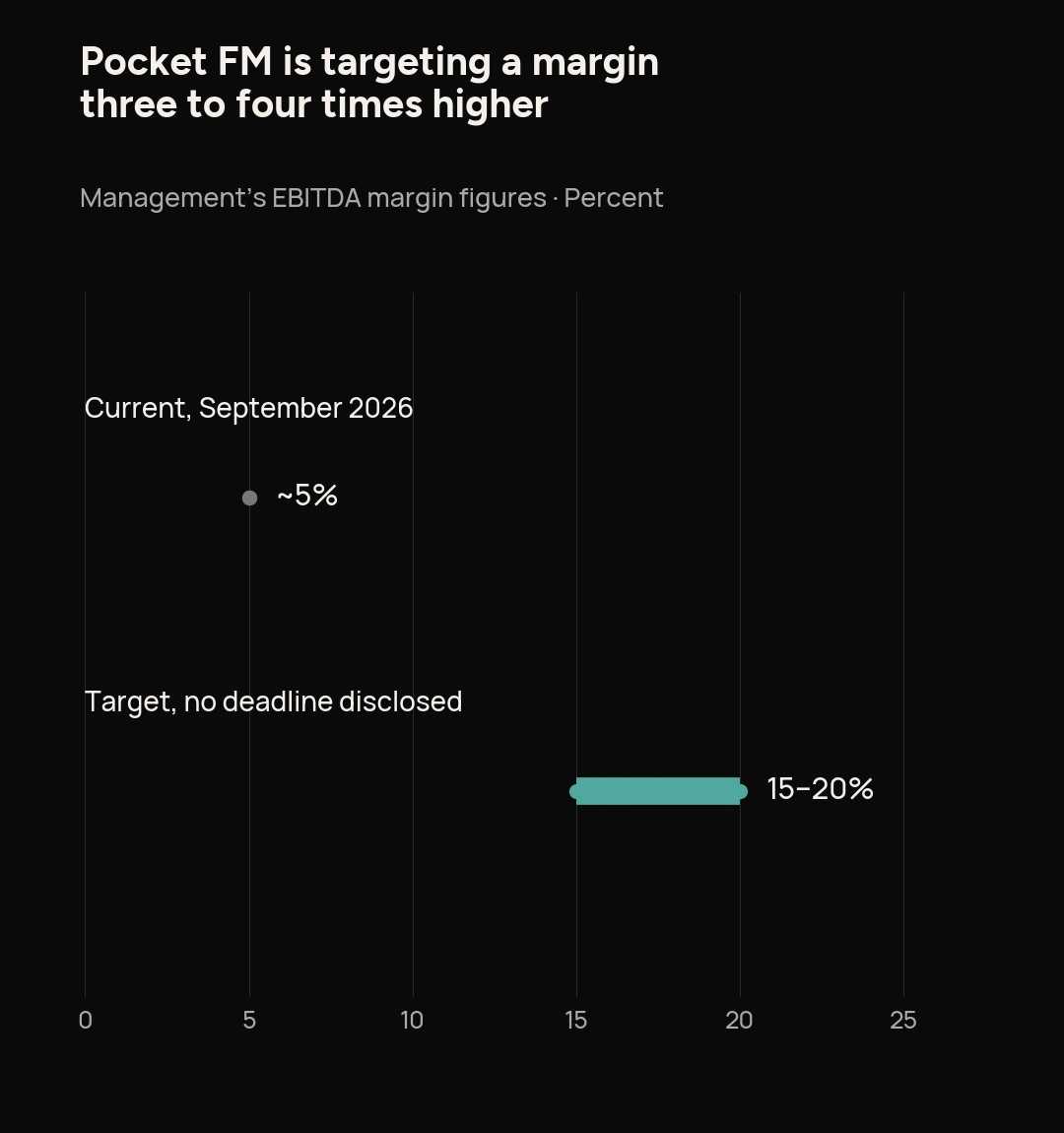
Chart: Technology Index · Data: Inc42 interview with Prateek Dixit
Cheaper production has to create better economics
Pocket FM uses AI across writing, production, dubbing and post-production. Its new Sherpa tool is designed to help writers maintain plots across stories that can run for hundreds of episodes. The Economic Times reported the launch on September 19.
At its September launch, Sherpa was free, and Pocket FM said it did not expect near-term revenue from it. Its economic purpose is therefore indirect: lower creator friction, more usable intellectual property and a larger production funnel. The company still has to show whether that produces more completed series, higher hit rates or lower cost per monetised hour.
The 90% production figure is also a process-share claim, not a cost-share disclosure. AI can touch most pieces of a workflow while expensive human work remains at selection, quality control, rights management and marketing. A credible margin bridge would quantify production cost per episode, time to release, rejection rates and spending required to acquire listeners.
ARR scale does not settle profit quality
Pocket Entertainment says its annualised revenue run rate has passed $500 million, up 70% year on year. Financial Express also reported company claims that 96 titles have generated more than $1 million each and 13 have exceeded $10 million.
ARR is useful for describing the current pace of recurring or repeatable revenue. It is not the same as audited revenue recognised over a completed financial year. The company has not publicly supplied the reconciliation from the $500 million run rate to statutory revenue, EBITDA or cash flow.
The hit data is strategically important because a larger catalogue does not guarantee better economics. A relatively small group of successful titles may support a long tail that never recovers its acquisition and production costs. AI can reduce the cost of experimentation, but it can also increase catalogue volume faster than discovery demand.
International expansion spends before it earns
Japan and South Korea add languages, local storytelling conventions, distribution choices and marketing competition. Pocket FM is also considering AI anime, interactive stories and gaming. Each format can extend intellectual property, but each brings its own product and customer-acquisition cost.
That creates a sequencing risk. If the company enters new markets while simultaneously increasing formats, aggregate revenue can grow even as cohort payback weakens. The missing disclosure is a market-level contribution view: revenue, paid acquisition, retention and content cost by geography.
Pocket FM has raised $196 million and was valued at $750 million in a $103 million Series D in 2024, according to Inc42. The margin target is therefore part of a broader capital story. Stronger margins would reduce dependence on additional private funding and improve the company’s options for a future listing. Missing the target while expanding could do the opposite.
What would prove the AI claim
The cleanest evidence would be a before-and-after cohort: comparable series produced with and without the newer AI workflow, showing cost, production time, completion, retention, revenue and rights disputes. A second useful disclosure would reconcile ARR to recognised revenue and cash collection. A third would separate mature-market margin from the cost of entering Japan and South Korea.
Pocket FM’s thesis is plausible: software can lower the cost of generating, translating and adapting long-form entertainment. Its stated 15%–20% margin is still a target without a disclosed date. Until the operating bridge is public, the 90% AI-production figure explains management’s confidence more than it proves the profit outcome.
Rights and quality can turn savings into liabilities
Content automation has costs that do not sit neatly inside production speed. The company must establish who owns AI-assisted scripts, voices and adaptations; how creators consent and are compensated; and how it handles outputs that resemble protected work. Quality failures can also raise refunds, moderation expense and brand risk even when the cost per generated episode falls.
These controls belong in the margin bridge because remediation is an operating cost. A durable 15%–20% margin would be more credible if Pocket FM disclosed rights disputes, content-removal rates, human-review intensity and creator payouts alongside AI coverage. Efficiency is strongest when it lowers cost without weakening retention or creating future claims.
One email. Saturday morning.
The week that mattered.
The five stories you needed to read, the data point of the week, and what to watch. From Technology Index editors. No ads, no fluff.