


UPI’s October 15 fee puts high‑value payments to the test
Selected bank-account-funded payments above ₹2,000 are scheduled to cost merchants up to 0.4% from October 15, 2026. Customers remain exempt.
From October 15, 2026, the National Payments Corporation of India is scheduled to apply a 0.4% merchant discount rate to selected UPI merchant payments above ₹2,000, according to an official Department of Financial Services FAQ and Reuters. The fee is capped at ₹300 for transactions of ₹75,000 or more. Eligible P2PM small merchants receiving no more than ₹1 lakh a month through QR-based UPI remain exempt. Consumers are not supposed to be charged.
The rule is narrow on paper. Economically, it redraws the boundary among public subsidy, bank infrastructure and merchant acceptance. UPI processed 24.51 billion transactions worth ₹29.82 lakh crore in August 2026, according to NPCI’s product statistics. A system of that scale cannot be financed by rhetoric. Someone pays for fraud controls, switching, customer support, bank systems and constant capacity.
The question is whether the new rule charges the right part of the network without weakening the habit that made UPI ubiquitous.
The ₹2,000 line separates frequency from value
UPI’s average transaction value in August was about ₹1,217, calculated by dividing ₹29.82 lakh crore by 24.51 billion transactions. That average combines personal transfers and merchant payments, so it cannot establish how many purchases cross the threshold. The official FAQ separately says payments of ₹2,000 or less account for more than 95% of P2M transaction volume.
The Financial Express estimated that payments above ₹2,000 represent only about 4% of merchant transactions but 67% of person-to-merchant value. If that estimate is correct, the fee targets a small share of payment events and a large share of rupees moved. It preserves the consumer habit of using UPI for tea, taxis and small retail while asking higher-ticket merchants to contribute.
That design is economically coherent, but behaviour happens at the margin. A ₹1,999 payment and a ₹2,001 payment receive different treatment. Merchants can split bills, steer customers to cards or cash, change which UPI instrument they accept, or absorb the charge. Each response alters the revenue the policy expects to collect.
The threshold will work only if avoidance costs more than compliance and enforcement does not burden legitimate small merchants.
The headline rate is simple; the schedule is not
At 0.4%, a ₹10,000 transaction creates a ₹40 merchant fee. A ₹50,000 transaction creates ₹200. At ₹75,000, the calculation reaches ₹300 and the cap begins to bind. Above that amount, the effective rate falls: ₹300 on ₹1 lakh is 0.3%; on ₹2 lakh it is 0.15%.
The FAQ excludes UPI mandates and AutoPay from prescribed MDR. Credit-card-linked UPI and pre-sanctioned credit lines continue under separate pricing rules.
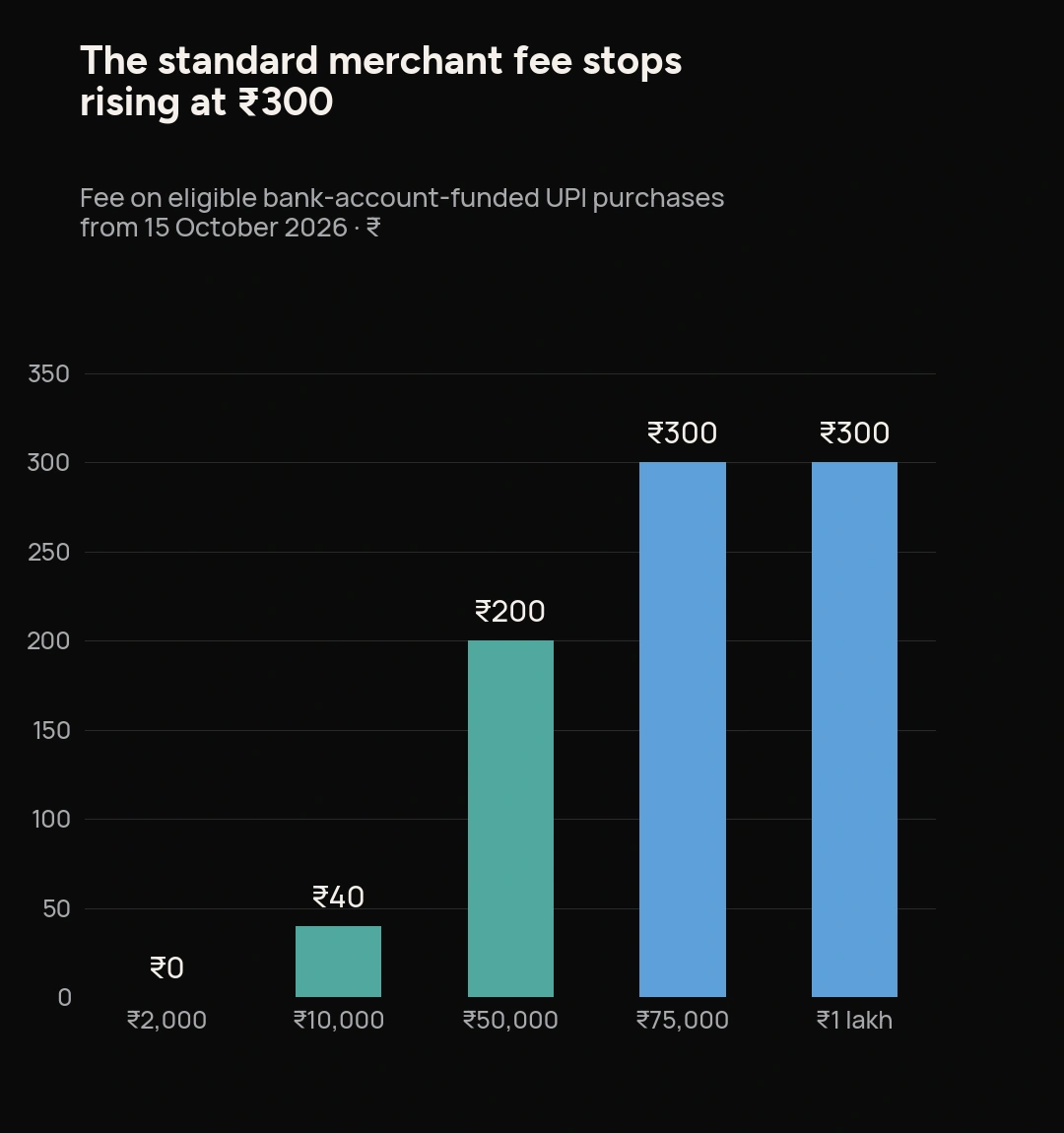
Chart: Technology Index · Data: Department of Financial Services
Selected sectors receive different treatment. Reuters reported a flat ₹5 charge for categories including railways, fuel and telecom. Capital-market payments carry a 0.02% rate with a ₹300 cap. The policy therefore does not establish a single market price for UPI. It creates a managed schedule based on transaction size, merchant type and policy sensitivity.
That complexity can protect thin-margin or public-service transactions, but it raises classification and implementation risk. A payment aggregator must know which merchant category applies, whether the merchant qualifies for the small-business exemption and whether the transaction falls under a special rate. Incorrect coding can overcharge one merchant and undercharge another.
The rule also requires clarity on refunds, partial refunds, reversals, split settlements and marketplaces. A consumer may pay a platform whose underlying sellers have different turnover and category profiles. The fee architecture must decide whether classification follows the platform, the seller, the goods or the settlement route.
These details determine whether the policy feels like a clean infrastructure charge or a tax administered by payments companies.
The payment base is not the fee pool
A Financial Express analysis annualised an estimated ₹6 lakh crore of monthly high-value merchant payments to ₹72 lakh crore. Applying 0.4% to that annual flow gives ₹28,800 crore before exemptions, concessions and caps. This is a mechanical scenario based on the reported payment base, not a revenue forecast.
Exempt small merchants reduce the chargeable base. Sector-specific flat fees and the ₹300 cap reduce the effective rate. Behavioural changes can reduce it further. The revenue is then distributed across the participants that originate, route and settle the payment, subject to the final rules.
NPCI will direct 5% of MDR collections to a fund for small merchants, Reuters reported. Applying that share to the hypothetical ₹28,800 crore would give ₹1,440 crore. Actual collections and the fund contribution depend on the eligible transaction mix.
The useful measure is not gross collections alone. It is the net funding reaching banks and payment providers after exemptions, fund contributions, compliance costs and incentives. If the distribution does not reflect who bears operating and fraud costs, the fee can exist without fixing the network’s economics.
Banks have carried a growing system without ordinary merchant pricing
UPI’s zero-MDR policy helped merchants adopt QR payments quickly. It removed a visible reason to prefer cash and let even tiny sellers accept a bank transfer without purchasing a card terminal. Government incentives and the network’s scale supported the model.
But zero price at the merchant interface did not mean zero cost. Banks maintain accounts, authenticate customers, investigate disputes and absorb some fraud and support expense. Payment apps fund software, risk systems and customer acquisition. NPCI operates network infrastructure. Merchants and consumers also bear costs through devices, connectivity, reconciliation and failed payments.
When those costs are not recovered per transaction, they are funded through public incentives, other banking revenue, investor capital or cross-subsidy. Each source can be justified during adoption. None should remain invisible once the system handles tens of billions of monthly transactions.
The new fee is therefore an attempt to move part of the burden toward commercial usage. It does not prove that 0.4% is the correct rate. That requires cost data the public debate rarely sees: fraud loss by payment type, support cost, switching cost, uptime investment and revenue earned from the customer relationship.
Cards are the wrong benchmark unless rewards and credit are included
Merchant fees on cards are often higher than the new UPI charge, making 0.4% look modest. The products are not identical. Credit cards bundle payment with short-term credit, rewards, chargeback rights and a global acceptance system. Debit cards connect directly to bank balances but may still include terminal and scheme costs. UPI is an account-to-account system built around mobile authentication.
A merchant compares the total proposition: fee, settlement speed, failure rate, fraud liability, reconciliation and sales conversion. A consumer compares convenience, credit, rewards and protection. If a high-ticket buyer receives rewards on a card while UPI offers none, merchant steering can interact with consumer preference.
The policy goal should not be to make UPI cheaper than every alternative at any cost. It should preserve vigorous competition among payment methods while ensuring that prices reflect services and do not exploit market power.
The no-pass-through rule will be tested in the real world
The official design says merchants cannot pass the charge to consumers. Direct surcharges may be easy to prohibit and hard to detect. A merchant can offer a cash discount, withdraw a UPI option for high-value purchases or incorporate the fee into general prices. Online platforms can change convenience fees or payment promotions.
Retailer and broker groups pushed back after the announcement, Reuters reported, warning of litigation and a potential shift back to cash. Their claims represent affected parties, not proof that the outcome will occur. Still, the reaction identifies where the system is most sensitive: businesses with thin margins, large tickets or easy alternatives.
A planned October 2 “No UPI Day” protest was withdrawn after talks with the finance minister, Loksatta reported on September 30. The withdrawal of the protest should not be read as cancellation of the fee schedule. Merchant response after implementation remains the test.
A 0.4% charge on a grocery basket may exceed the retailer’s payment-processing margin assumptions. On a durable good, the absolute fee can be absorbed within a larger gross profit. In securities transactions, even a small payment friction interacts with regulated charges and high volumes, which helps explain the separate 0.02% rate.
The policy should be monitored by sector rather than through a single national average.
Small-merchant protection creates a verification problem
The ₹1 lakh monthly QR-UPI exemption is intended to protect small sellers. A threshold based on received payments is easy to state and difficult to administer across multiple accounts, apps and acquiring relationships.
The FAQ provides one transition rule: a P2PM merchant whose incoming UPI payments exceed ₹1 lakh a month for three consecutive months moves to P2M. A genuine small seller may also use several QR codes because customers prefer different apps or bank service is unreliable. Aggregation across those relationships affects how the threshold works in practice.
Verification should minimise document demands on the businesses the exemption is designed to help. Network-level aggregation can reduce self-reporting, but it also requires clear rules on data use and merchant identification. The three-month transition gives some protection against a single seasonal spike.
If qualification is unstable, banks and aggregators may reserve fees until status is confirmed. That would create working-capital friction for small merchants. The simplest exemption is valuable only if settlement remains predictable.
UPI grew almost 10% in volume from April to August
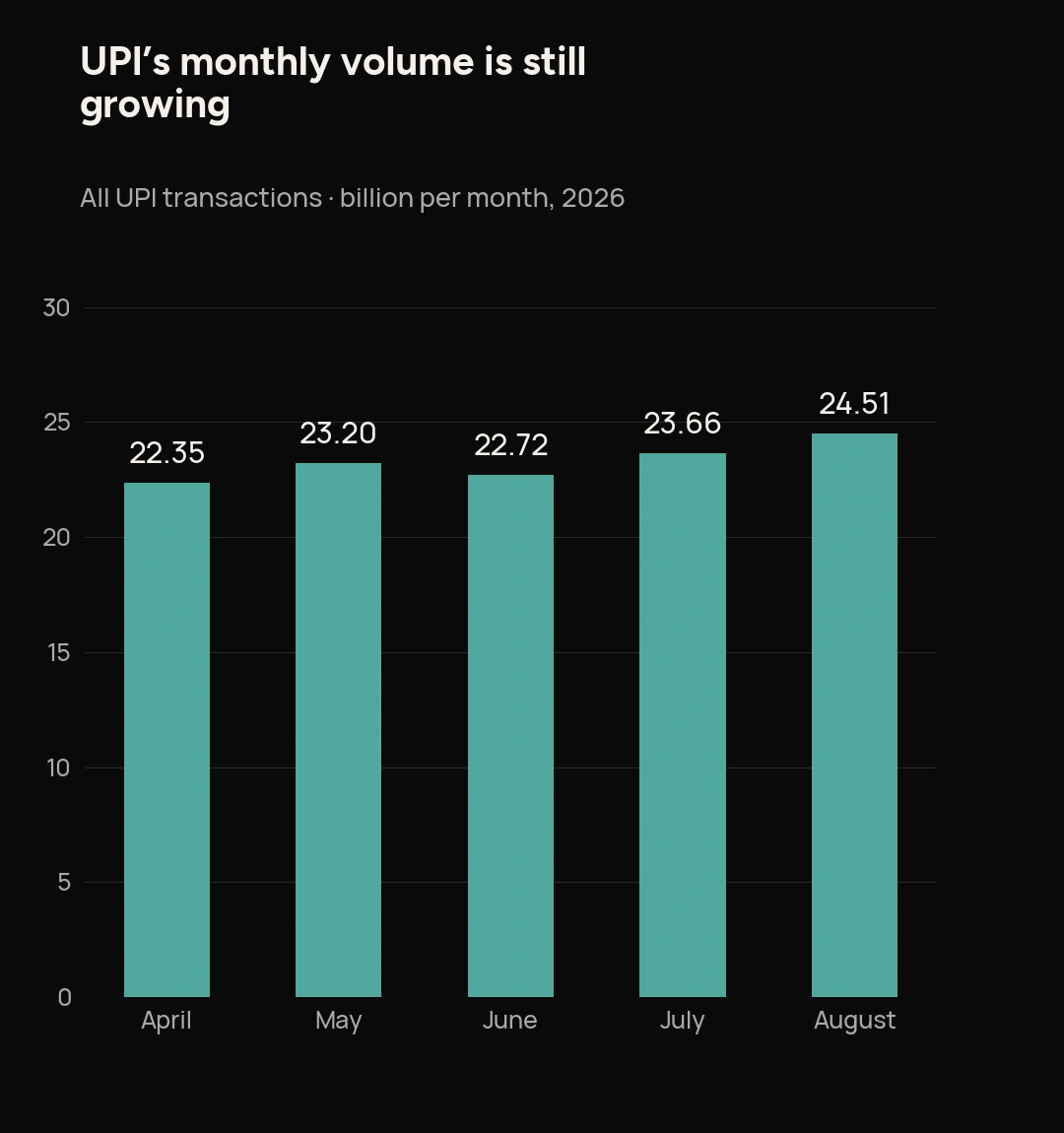
Chart: Technology Index · Data: NPCI
NPCI data show transaction volume rising from 22.35 billion in April to 24.51 billion in August, an increase of about 9.7%. The number of banks live on UPI increased from 713 to 752, about 5.5%. Transaction value moved around ₹29 lakh crore each month rather than following a straight line.
Those figures describe a mature network still adding capacity and participants. They also provide a baseline for evaluating the fee. After October, observers should track high-value merchant volume, average ticket, cash usage, card usage, payment splitting, merchant acceptance and failure rates. Total UPI growth alone can hide a retreat in the affected segment.
A clean evaluation would compare similar merchants before and after the rule, controlling for festivals, inflation and seasonal sales. It should distinguish new merchants from existing merchants and person-to-person transfers from commercial payments. Without that design, each side will select the aggregate that supports its prior position.
Pricing can improve service if accountability follows
Merchants are more likely to accept a fee when it buys measurable service. NPCI and participating institutions should publish uptime, failure rates, dispute-resolution times and fraud outcomes by channel. The fee distribution should create incentives to invest in the part of the system causing failure.
Service commitments matter particularly for high-value payments. A failed ₹100 payment is irritating; a failed ₹1 lakh payment can disrupt delivery, trigger duplicate attempts or tie up funds. A network that charges for larger transactions should offer a clear status, fast reversal and accessible escalation.
The policy should also separate fraud prevention from victim compensation. Strong authentication reduces unauthorised transfers, but social engineering can persuade a customer to approve the wrong transaction. Banks and apps need shared incentives to detect anomalous payments without blocking legitimate commerce.
The political contract around UPI is changing
UPI became part of everyday economic life partly because users experienced it as a public utility: instant, interoperable and free at the point of use. Introducing a merchant fee does not privatise the network, but it changes expectations. The state and NPCI now have to explain which services are public infrastructure, which are commercial and who pays for each.
That distinction should be explicit. Basic person-to-person transfers and small-merchant acceptance can remain protected for inclusion reasons. Higher-value commercial payments can carry a fee if the rate is transparent, proportionate and attached to service obligations. Innovation layers, credit, loyalty, analytics and merchant software, can be competitively priced.
Trying to keep every layer free eventually produces hidden subsidies or underinvestment. Charging every layer risks weakening inclusion. The design challenge is to keep the public rail broad while allowing sustainable businesses to operate on top of it.
The first six months will decide whether 0.4% is durable
The reform should be judged on four outcomes. Did high-value merchants continue accepting UPI? Did the payment mix shift toward cash or cards? Did banks and providers improve reliability? And did the burden fall where the policy intended rather than leaking to consumers and exempt sellers?
If acceptance holds and service improves, the ₹2,000 threshold may become a workable compromise between free access and network funding. If merchants split payments, remove UPI or create indirect surcharges, the schedule will need revision. If revenue arrives without visible service improvement, opposition will harden.
UPI’s achievement was not simply replacing cash with QR codes. It created a shared network in which banks, fintechs and merchants could meet under common rules. The next achievement must be economic durability.
The rate will be judged at the shop counter and in the bank’s service record. Merchants need to know what they pay, customers need protection against surcharges, and both need payments that settle reliably.
One email. Saturday morning.
The week that mattered.
The five stories you needed to read, the data point of the week, and what to watch. From Technology Index editors. No ads, no fluff.